


Search for information about cinnamon Ragdolls and you can quickly find completely contradictory answers.
One article may say cinnamon is an accepted Ragdoll color. Another may claim it is not a real Ragdoll color at all. Breeder websites may use terms such as “new color,” “non-traditional,” “rare color,” or “cinnamon point,” often without explaining what those terms actually mean.
That confusion is understandable because several different questions are often mixed together.
Does cinnamon exist genetically in cats? Yes.
Can a Ragdoll express cinnamon? Yes.
Do all cat registries use the same Ragdoll color standard? No.
Was cinnamon part of the original Ragdoll foundation population? Not in the same way as the breed’s established traditional colors.
Understanding those distinctions makes the subject much clearer and helps prospective families evaluate claims about cinnamon Ragdoll cats without relying on marketing language alone.
Table of Contents
What is a cinnamon Ragdoll?
Is cinnamon a genuine genetic color?
Why cinnamon was not common in early Ragdolls
How cinnamon was developed within Ragdoll lines
The significance of the 2007 breeding milestone
TICA and cinnamon Ragdolls today
Why CFA information looks different
Why registry differences create online confusion
Cinnamon, chocolate and fawn are not interchangeable
How prospective owners can verify a cinnamon claim
Why pedigree and DNA information both matter
What “rare” should and should not mean
Why preserving Ragdoll type matters
Final thoughts
What Is a Cinnamon Ragdoll?
A cinnamon Ragdoll is a Ragdoll carrying the genetic combination that produces cinnamon pigmentation.
In pointed Ragdolls, this warm pigment appears most strongly on cooler areas such as the:
face
ears
legs
feet
tail
The body remains lighter because pointed coloration is temperature-sensitive.
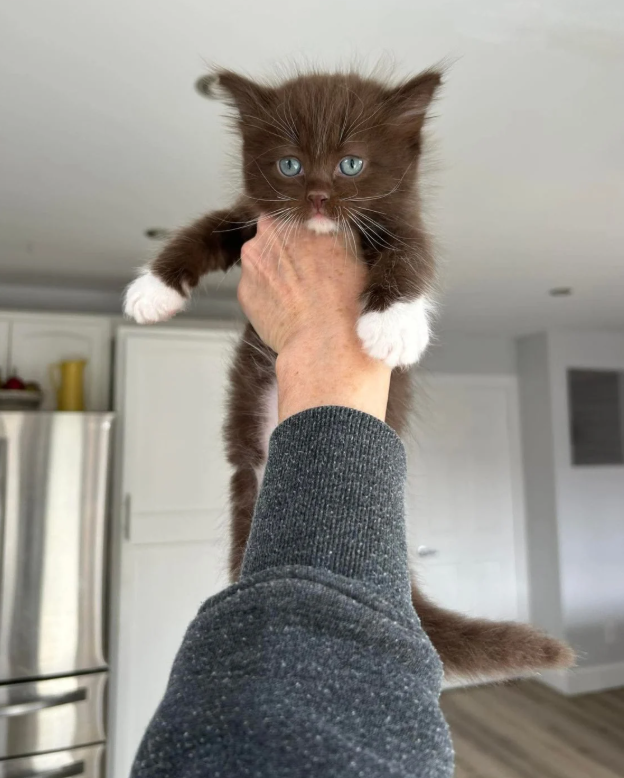
Visually, cinnamon tends to be warmer and lighter than chocolate. It can appear reddish-brown, softly copper-toned, or warm caramel depending on the individual cat, its age, pattern, and lighting.
However, appearance is only part of the definition.
Cinnamon has a specific genetic basis, which means a kitten should not be called cinnamon simply because it happens to look warm brown in a photograph.
Is Cinnamon a Genuine Genetic Color?
Yes.
Cinnamon is a documented feline coat-color variation associated with the B locus.
The Veterinary Genetics Laboratory at the University of California, Davis describes three important alleles in this color series:
B – full black-based pigmentation
b – chocolate
bˡ – cinnamon
Their dominance order is:
B > b > bˡ
For a cat to visibly express cinnamon at this locus, it inherits cinnamon from both parents:
bˡ/bˡ
That makes cinnamon genetically different from chocolate.
A cat with:
b/bˡ
will generally appear chocolate while carrying cinnamon because chocolate is dominant to cinnamon.
Likewise, a cat with:
B/bˡ
can carry cinnamon without looking cinnamon at all.
Therefore, cinnamon is not an invented shade or a breeder-created marketing description. It is a real, testable coat-color genotype.
The more complicated question is how that gene became established in Ragdoll breeding lines.
Why Cinnamon Was Not Common in Early Ragdolls
The Ragdoll breed was developed in California beginning in the 1960s.
The breed became associated with its large size, semi-long coat, blue eyes, pointed appearance, and gentle temperament.
Colors such as seal, blue, chocolate, and lilac became familiar within established Ragdoll breeding programs.
Cinnamon was different.
The required cinnamon allele was not widely available within traditional Ragdoll bloodlines. Therefore, producing genuine cinnamon could not simply be achieved by pairing two ordinary brown-looking Ragdolls.
The gene had to exist in the breeding population first.
That eventually led breeders interested in cinnamon to undertake a much longer project: introduce the genetic color and then breed repeatedly toward established Ragdoll characteristics.
This history is important because it explains why cinnamon can be both a legitimate genetic color and a later development within the Ragdoll breed.
Those ideas are not contradictory.
How Cinnamon Was Developed Within Ragdoll Lines
One of the most useful surviving first-hand accounts comes from veterinarian and breeder Dr. Maxine Stiles of Dollnouveau Ragdolls.
Dr. Stiles documented working with long-time Ragdoll breeder Sharon Steadman on a project designed to establish the cinnamon gene within Ragdoll lines.
The project was not simply about producing a cinnamon-colored cat.
Once breeders had access to the cinnamon allele, they still needed to work toward cats that displayed the physical structure, coat, personality and other characteristics expected of Ragdolls.
That required repeated generations of breeding back toward Ragdolls.
Dr. Stiles described the goal as preserving the desired cinnamon genetics while removing characteristics that did not fit the Ragdoll type.
This distinction matters.
Introducing a gene can happen relatively quickly.
Building a stable breeding line that consistently resembles the target breed can take years.
The 2007 Breeding Milestone
According to Dr. Stiles’ own account of the project, TICA required several generations of breeding back to Ragdolls before full SBT registration status could be regained.
She reports achieving the project’s first SBT registration papers in 2007 with:
Dollnouveau Dr Pepper
a fawn mitted point.
Fawn is closely related to cinnamon genetically because fawn is the dilute expression associated with cinnamon pigmentation.
The 2007 milestone did not mean that every registry suddenly adopted cinnamon into every Ragdoll standard.
Instead, it represented an important stage in the documented development of these color lines.
That difference is essential when discussing the history accurately.
TICA and Cinnamon Ragdolls Today
One reason older articles can mislead readers is that registry standards and published information can change.
The International Cat Association’s current Ragdoll breed information explicitly lists:
seal
blue
chocolate
lilac
cinnamon
fawn
red
cream
as Ragdoll colors.
TICA also describes traditional pointed Ragdolls as blue-eyed cats with a lighter body and darker face, legs, tail, and ears.
The organization lists three familiar Ragdoll patterns:
colorpoint
mitted
bicolor
This makes one current fact particularly important:
It is inaccurate today to make the blanket statement that TICA does not list cinnamon as a Ragdoll color.
Some websites continue to repeat that claim, often because they are relying on older information or confusing TICA with another registry.
Why CFA Information Looks Different
The Cat Fanciers’ Association uses its own Ragdoll breed standard.
Its published descriptions include traditional point colors such as:
seal
blue
chocolate
lilac
red
cream
Cinnamon is not separately listed among those standard point colors in CFA’s Ragdoll standard.
That does not prove that cinnamon pigment cannot exist in a Ragdoll.
It means CFA and TICA do not use identical standards for the breed.
This is a crucial distinction.
A statement such as:
“Cinnamon is recognized.”
is incomplete without asking:
Recognized by whom?
Likewise:
“Cinnamon is not a recognized Ragdoll color.”
may accurately describe one organization’s standard but become false when presented as a universal rule.
Why Registry Differences Create So Much Confusion
Many online articles treat “recognized” as though there were one worldwide authority deciding every acceptable cat color.
There isn’t.
Different registries maintain their own:
breed standards
registration policies
color classifications
show rules
terminology
This means two legitimate organizations can classify the same type of cat differently.
The situation becomes even more confusing when older articles remain indexed for years after registry information changes.
A reader may therefore encounter:
“TICA recognizes cinnamon.”
and five minutes later find:
“No major organization recognizes cinnamon.”
The best way to resolve that conflict is simple:
check the current primary source from the registry being discussed.
That is far more reliable than copying statements between breeder blogs.
Cinnamon, Chocolate and Fawn Are Not the Same Color
Another source of misinformation is the tendency to group all warm Ragdolls together.
Chocolate and cinnamon are genetically related, but they are not identical.
At the B locus:
B > b > bˡ
Chocolate results from the chocolate allele when it is not masked by full pigment.
Cinnamon requires two cinnamon alleles.
Therefore, a chocolate cat can carry cinnamon without expressing it.
What about fawn?
Fawn is associated with dilution acting on cinnamon.
In simplified terms:
cinnamon + dilution = fawn
This parallels other familiar relationships such as:
seal/black-based pigment + dilution → blue
and:
chocolate + dilution → lilac
That is why fawn often appears alongside cinnamon when uncommon feline coat colors are discussed.
How Can a Family Verify a Cinnamon Claim?
Someone searching for a cinnamon Ragdoll cat should not be expected to become an expert in feline genetics.
However, a few basic questions can separate useful information from vague marketing.
Ask about the parents
What colors are they?
Do they carry cinnamon?
How is that known?
A breeder should be able to explain the pairing in understandable terms.
Ask whether genetic testing is available
The B locus can be DNA tested.
UC Davis, for example, offers testing that distinguishes:
full-color cats
chocolate carriers
cinnamon carriers
chocolate cats
chocolate cats carrying cinnamon
cinnamon cats
DNA testing can therefore provide useful evidence when breeders are working with rare coat-color genetics.
Ask to see the pedigree
DNA testing answers one question:
Which coat-color variants does this cat carry?
A pedigree answers a different question:
Where does this cat come from?
Both pieces of information can be useful.
Ask for natural-light photographs
Warm indoor lighting can make chocolate appear more reddish.
A true color assessment is easier when families can see:
natural daylight photographs
multiple angles
video
different ages
parents or older relatives
Ask how old the kitten is
Ragdolls develop color gradually.
A young kitten may look dramatically paler than it will as a mature adult.
TICA notes that Ragdolls may not reach their full color until around three years of age.
DNA Does Not Replace Pedigree
It is easy to assume that a DNA result solves every question.
It does not.
A coat-color test can establish whether a cat carries or expresses specific known variants.
It cannot, by itself, establish the entire breed history of that cat.
Likewise, a pedigree can document ancestry but cannot always reveal every hidden color allele without additional genetic information.
The strongest documentation therefore combines:
pedigree + known parentage + breeder records + genetic testing where useful + accurate phenotype observation
No single piece should be expected to answer every question.
What Does “Rare” Actually Mean?
The word rare is heavily used in pet advertising.
Sometimes accurately.
Sometimes not.
Cinnamon genuinely remains much less common in Ragdolls than colors such as seal or blue because the necessary recessive genetics are less widespread within the breeding population.
Producing cinnamon also requires specific genetic combinations.
However, rarity should not automatically mean:
healthier
better temperament
more affectionate
better breed type
higher quality
Color and quality are separate issues.
A rare kitten that has not been thoughtfully bred is still poorly bred.
Likewise, an excellent seal Ragdoll is not somehow inferior because seal is more common.
Rare color should describe availability, not overall worth.
Preserving Ragdoll Type Matters
This may be the most important lesson from the cinnamon breeding project’s history.
Introducing or preserving an uncommon color should not become the only goal.
A Ragdoll should still be bred with attention to the qualities that define the breed.
These include:
appropriate structure
coat
temperament
health
size and development
recognizable Ragdoll characteristics
The original cinnamon development work illustrates why this takes time.
Once the color gene was present, breeders still spent generations selecting back toward Ragdoll type.
That principle remains relevant today.
Responsible rare-color breeding should ask:
Can we preserve the color without losing sight of the rest of the cat?
Why Temperament and Health Still Come First
A family may discover cinnamon because of appearance.
That is perfectly reasonable.
An uncommon warm-colored Ragdoll can be striking.
However, once the kitten becomes part of the household, its exact shade of brown becomes only one part of everyday life.
Families will care much more about whether the cat is:
healthy
confident
affectionate
properly socialized
comfortable with handling
suited to the household
receiving appropriate veterinary care
Therefore, prospective owners should be cautious of any breeder whose entire program is described only through words such as:
rare
exclusive
exotic
unusual
without similar attention to health, temperament, pedigree, and responsible placement.
A Better Way to Talk About Cinnamon Ragdolls
Instead of asking:
“Are cinnamon Ragdolls real?”
a better set of questions is:
Does cinnamon exist genetically?
Yes.
Can Ragdolls carry and express cinnamon?
Yes.
Was cinnamon one of the commonly established original Ragdoll colors?
No; its development within modern Ragdoll lines came later.
Does TICA currently list cinnamon as a Ragdoll color?
Yes.
Does CFA currently use the same color list?
No.
Can cinnamon be verified genetically?
Yes, through appropriate coat-color DNA testing.
Those answers provide a much more accurate picture than a simple yes-or-no headline.
Final Thoughts
Cinnamon Ragdolls sit at an interesting intersection of feline genetics, breed history, and changing registry standards.
The cinnamon color itself is scientifically well documented. It results from a recessive genetic combination at the B locus and is genetically different from chocolate.
Its presence within Ragdoll lines has a later history, including documented efforts by breeders to establish the color and then breed repeatedly toward Ragdoll type.
That history helps explain why different registries and different websites sometimes describe cinnamon differently.
Today, TICA’s own Ragdoll information explicitly includes cinnamon among the breed’s listed colors, while CFA maintains a different Ragdoll color standard.
For prospective families, the most useful approach is therefore not to rely on statements such as “real,” “rare,” or “recognized” without context.
Ask which registry is being discussed. Learn about the kitten’s parents. Look at the pedigree. Use DNA information when appropriate. Compare natural-light photographs and understand that Ragdoll color develops slowly.
Most importantly, evaluate the entire cat.
Cinnamon may be the feature that first attracts attention, but health, temperament, responsible breeding and a good household match are what ultimately make a Ragdoll a successful companion.

The Collar, the Tag, and the Story: Choosing Details for a Pet Portrait
Never Be Your Cat’s Alarm Clock Again: The Smart Feeder Revolution
